Every year, tens of thousands of UK pilgrims travel to Makkah to perform Umrah. Some have done it before and are returning. Many are doing it for the first time — nervous, excited, a little unsure of exactly what happens and in what order. This guide is written for both groups, but particularly for those who want a clear, honest account of the process from the perspective of someone departing from Britain.
It covers every step of Umrah in plain language, explains what to expect at each stage, and includes the practical details specific to UK pilgrims that generic guides tend to leave out — from what happens at the airport before you board to the moment your Umrah is complete and you stand at Safa looking back at the Kaaba.
Before the Flight — What UK Pilgrims Need to Arrange
UK pilgrims have several specific preparation tasks that go beyond simply knowing the Umrah rituals. These need to be completed before departure, not on arrival.
Passport validity check — your UK passport must have at least six months of validity remaining from your arrival date in Saudi Arabia, not your departure date from the UK. Many pilgrims miscalculate this. If your passport expires within nine months of your travel date, renew it before booking anything.
Meningitis ACWY vaccination — mandatory Saudi entry requirement for all Umrah pilgrims from the UK. Book through your NHS GP at least six to eight weeks before departure. Carry the printed certificate in your hand luggage. Saudi border authorities check this rigorously.
Nusuk app registration — the Saudi government now manages pilgrimage activities through the Nusuk digital platform. UK pilgrims must register before departure. The app is used to book Rawdah permits at Masjid an-Nabawi in Madinah, manage Tawaf access during busy periods, and handle various pilgrimage documentation. Your travel agency should walk you through this — at Safar-e-Kaaba, we assist every pilgrim with Nusuk setup as part of the standard pre-departure preparation included in all our packages.
Umrah visa — processed by your travel agency on your behalf. All you need to provide is your passport details, photograph, and the required documentation. Do not leave this to the last week before travel.
Spiritual preparation — learn the Talbiyah, the key duas for each stage of Umrah, and the intention (Niyyah) you will make on entering Ihram. Read about what each ritual means. Pilgrims who arrive in Makkah having prepared spiritually as well as logistically describe the experience very differently from those who arrive knowing only the mechanical steps.
Step 1 — Entering Ihram
Ihram is the sacred state that marks your entry into the Umrah rituals. It is both a physical preparation and a spiritual declaration.
For men, Ihram means wearing two pieces of unstitched white cloth — one wrapped around the lower body, one draped over the left shoulder leaving the right bare. Open sandals are worn, the head remains uncovered, and no stitched garments are permitted. Choose a medium-weight cotton Ihram set from an Islamic clothing shop in the UK before you travel — thin, cheap sets slip constantly during Tawaf.
For women, there is no specific Ihram garment. Any modest, loose-fitting clothing is acceptable. The face and hands must remain uncovered — covering them during Ihram is not permitted.
When to enter Ihram — for UK pilgrims flying to Jeddah, the aircraft crosses the Miqat boundary during the flight. Many experienced UK pilgrims recommend entering Ihram before check-in at your UK airport to avoid any anxiety about missing the in-flight announcement. Perform ghusl, put on your Ihram garments, and make your intention before boarding.
The intention (Niyyah): Labbayk Allahumma Umratan — “O Allah, here I am to perform Umrah.”
Then recite the Talbiyah: Labbayk Allahumma labbayk, labbayka laa shareeka laka labbayk. Inna al-hamd wa’l-ni’mata laka wa’l-mulk, laa shareeka lak.
Continue reciting the Talbiyah throughout your journey until you begin Tawaf. From this moment, certain actions are prohibited: cutting hair or nails, using scented products, covering the head (men) or face (women), and marital relations.
Browse our 3 Star Umrah Packages for UK pilgrims seeking an affordable first Umrah with all logistics — including visa, flights, and hotel — fully arranged so you can focus entirely on the spiritual preparation.
Step 2 — Arriving in Makkah and First Sight of the Kaaba
Most UK pilgrims fly into Jeddah and travel by road to Makkah — approximately an hour’s journey depending on traffic. Your airport transfer, arranged as part of your package, takes you directly to your hotel.
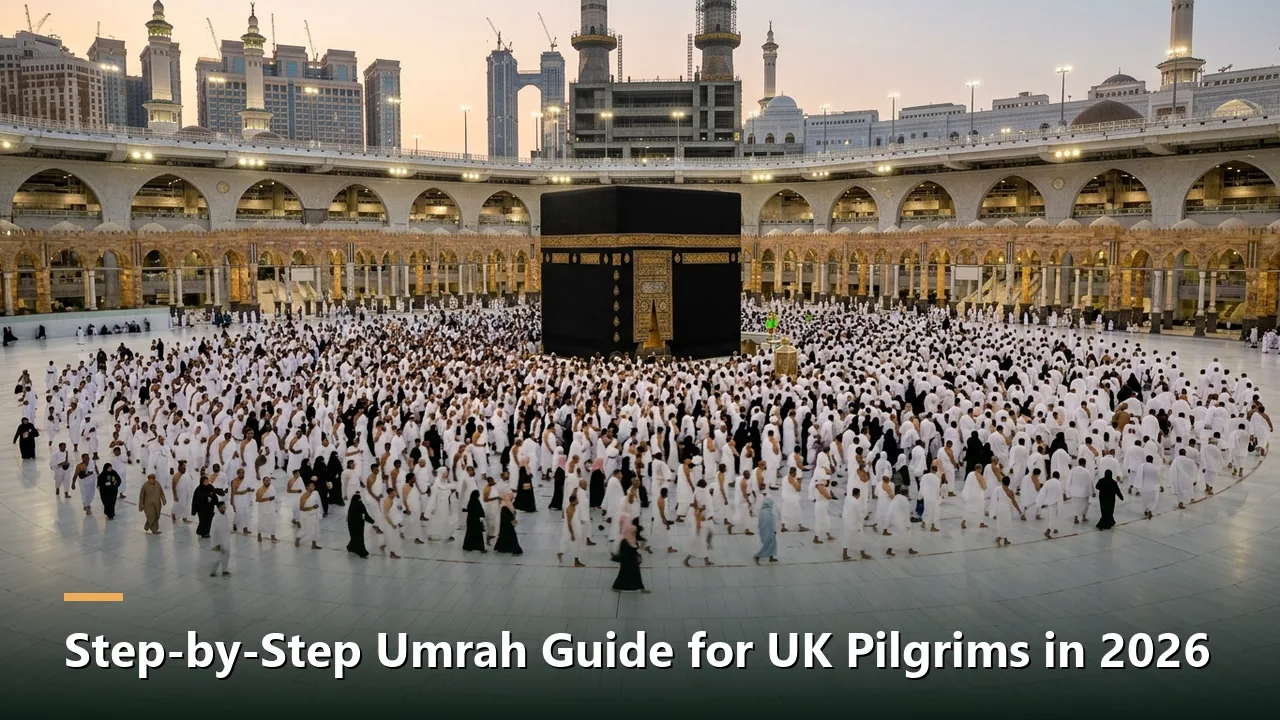
No preparation fully readies a UK pilgrim for the first sight of Masjid al-Haram from outside its gates. The scale of the minarets. The noise and movement of pilgrims from every Muslim country on earth. And then walking through the gate and seeing the Kaaba — black, ancient, present in a way that no image has ever captured — for the first time.
Most people stop. Many cry. Take a moment. You have been waiting for this.
Step 3 — Tawaf
Tawaf is the act of circling the Kaaba seven times in an anti-clockwise direction, beginning and ending at the Black Stone (Hajr al-Aswad) set into the eastern corner.
Before beginning, men perform Idtiba — uncovering the right shoulder by passing the upper Ihram cloth under the right arm. This position is maintained throughout Tawaf.
At the Black Stone, touch or kiss it if you can reach it safely. If the crowd makes this impossible — which it usually does — simply face the Stone, raise your right hand, and say Bismillah, Allahu Akbar. This is completely valid. Do not push into the crowd around the Stone.
Walk with the Kaaba on your left for all seven circuits. The inner circuits at ground level are the most crowded. UK pilgrims — particularly those performing Tawaf for the first time — are better served by the outer circuits or the upper floors, which are significantly less crowded and equally valid.
During Tawaf, recite any dua, Quranic verses, or dhikr that comes naturally to you. There is no single prescribed recitation for each circuit. Many UK pilgrims find this the most personally meaningful part of Umrah — walking around the house of Allah while speaking directly to Him in their own words.
After seven circuits, pray two rakats of Salat al-Tawaf near Maqam Ibrahim. If this immediate area is congested, anywhere within the Masjid is acceptable. Then go to Zamzam — drink it, make dua, and rest briefly before Sa’i.
Our 4 Star Umrah Packages include hotels within shorter walking distance of the Haram gates, which means less physical effort between your room and the Tawaf area — particularly relevant for UK pilgrims performing multiple voluntary Tawafs across their stay.
Step 4 — Sa’i
Sa’i is the act of walking seven times between the hills of Safa and Marwa. It commemorates the search of Hajar — wife of Ibrahim (peace be upon him) — for water in the desert for her infant son Ismail. Her desperate, determined movement between the two hills, and her unwavering trust in Allah that produced the miracle of Zamzam, is what every pilgrim re-enacts.
Begin at Safa. Face the Kaaba direction, raise your hands, and recite Inna al-Safa wa’l-Marwata min sha’a’irillah — the Quranic verse that begins the Sa’i. Make dua. Then walk toward Marwa.
Between the green markers in the Sa’i corridor, men walk briskly — this commemorates Hajar’s urgency. Women walk at a normal pace throughout.
Reaching Marwa completes circuit one. Walking back to Safa completes circuit two. Continue for seven circuits, ending at Marwa.
The Sa’i corridor is enclosed and air-conditioned — one of the more comfortable sections of the Masjid environment, particularly for UK pilgrims travelling in summer. The total combined distance across seven circuits is approximately 3.15 kilometres.
Step 5 — Halq or Taqsir
The final ritual of Umrah is cutting or shaving the hair. This act ends the state of Ihram and signifies completion.
For men, Halq — complete shaving of the head — is preferred and carries greater reward. Taqsir — trimming at least a fingertip’s length from all sections of the hair — is also valid. Barbershops are located immediately outside the Haram specifically for Hajj and Umrah pilgrims. For a first Umrah, many UK pilgrims choose Halq for the full spiritual experience of renewal it represents.
For women, only Taqsir is required — trimming a small amount from the ends of the hair. This can be done privately in your hotel room.
Once Halq or Taqsir is complete, your Umrah is finished. All Ihram restrictions are lifted. You can wear regular clothes, use scented products, and all other prohibited actions are permitted again.
The emotional quality of this moment is difficult to communicate. For many UK pilgrims, it is the point at which the weight of the experience — the standing in front of the Kaaba, the Tawaf, the Sa’i — lands fully, and the reality of what they have just done becomes clear.
After Umrah — Making the Most of Your Remaining Days
Completing the Umrah rituals marks the start of the most open and personally directed part of your trip. Most UK pilgrims spend additional days in Makkah performing voluntary Tawaf, making extended duas at the Kaaba, sitting in the Haram for prayers, and visiting nearby blessed sites including Jabal Nour and the Cave of Hira.
The majority of packages then include time in Madinah. October Umrah Packages and December Umrah Packages are popular with UK pilgrims who want comfortable weather conditions alongside adequate time in both cities. A standard 10-night package allocates five nights in Makkah and five in Madinah — a duration most UK pilgrims find enough to do justice to both cities, though many wish they had booked longer.
In Madinah, your priority is Masjid an-Nabawi and the Rawdah. Book your Rawdah permit through the Nusuk app before arriving in Madinah — the timed slots for access to the area around the Prophet’s grave fill quickly during peak periods.
Returning to the UK — What Comes After
Almost every UK pilgrim returns from Umrah with the same feeling: they want to go back. The experience changes your relationship to daily prayer, to the Quran, to the concept of community, in ways that take months to fully understand.
Many of the Safar-e-Kaaba team have performed Umrah themselves. We know what it means to stand where you are about to stand. That understanding is why we take the responsibility of arranging your journey as seriously as we do.
To book your Umrah from any UK departure city, call our Burnley office on +44 2071 930097 or reach our team through our Contact Us form. All our packages are ATOL-protected and fully inclusive. We will prepare a personalised quote within the hour.