Performing Umrah is one of the most spiritually significant journeys a Muslim can make in their lifetime. For British Muslims, it often begins with months of planning, prayer, and anticipation — and rightly so. But alongside the spiritual preparation, there is a practical side that many first-time pilgrims find daunting: exactly what happens once you arrive in Saudi Arabia?
This guide has been written specifically for UK pilgrims. It takes you through every step of Umrah in plain, clear language — from entering the state of Ihram on your flight out of Manchester or Heathrow, to the moment you leave Makkah with your pilgrimage complete. We have also included the honest, practical details that most guides leave out: what the crowds are actually like, what to do if you lose your group, and the small things that make a real difference to your experience.
Whether this is your first Umrah or you are returning after many years, take a few minutes to read through this before you travel. It may just be the most useful thing you read in your preparation.
What is Umrah and How is it Different from Hajj?
Umrah is often described as the lesser pilgrimage, though that description does not quite capture its significance. Unlike Hajj, which is obligatory once in a lifetime for those who are able, Umrah is a voluntary act of worship that can be performed at any time of year — with the exception of the specific days of Hajj.
The rituals of Umrah are fewer in number than those of Hajj but are deeply meaningful. There are four main acts: entering the state of Ihram, performing Tawaf around the Kaaba, completing Sa’i between the hills of Safa and Marwa, and finishing with Halq or Taqsir — cutting or shaving the hair. Together, they take between three and five hours to complete under normal conditions, though the time can stretch considerably during peak seasons such as Ramadan.
For UK pilgrims, the total trip usually lasts between seven and fourteen days, allowing time to visit both Makkah and Madinah, perform additional prayers in the Haramain, and absorb the spiritual atmosphere of these sacred cities.
Before You Fly: Preparation That Begins at Home
Umrah preparation does not begin at the airport. For UK pilgrims, there are several important steps to complete well in advance of your departure date.
Documents and Visa
Your UK passport must have at least six months of validity remaining from the date of your entry into Saudi Arabia. Most UK pilgrims travelling through a registered ATOL-protected agency like Safar-e-Kaaba will have their Umrah visa processed as part of the package — but it is worth confirming this explicitly when you book.
Since 2024, the Saudi government has used the Nusuk platform for pilgrimage management. Your travel agency should assist you in registering on the Nusuk app before departure, as it is used to book Rawdah (the Prophet’s Mosque) permits in Madinah and manage other pilgrimage logistics.
You will also need proof of your meningitis ACWY vaccination, which is a requirement for all pilgrims entering Saudi Arabia. If you have not had this, speak to your GP or a travel health clinic well before your departure.
Spiritual Preparation
Many scholars advise spending the weeks before Umrah in increased worship — reading Quran, making tawbah (repentance), and learning the duas and supplications that are recommended at each stage. You do not need to memorise everything, but becoming familiar with the key moments will make the experience far more meaningful.
Learn the Talbiyah, which you will recite from the point of entering Ihram. Practice the steps of Tawaf in your mind. Understand what Sa’i commemorates — the action of Hajar (Hagar) running between the hills in search of water for her infant son Ismail — so that when you perform it yourself, you feel its weight.
Step 1: Entering the State of Ihram
Ihram is the first and perhaps most important step of Umrah. It is both a physical state — marked by wearing specific garments and ceasing certain actions — and a spiritual one, representing the shedding of worldly concerns and the full turning of the heart towards Allah.
Ihram for Men
Male pilgrims wear two pieces of unstitched white cloth. One wraps around the waist and covers the lower body; the other is draped over the left shoulder, leaving the right shoulder bare during Tawaf (this is called Idtiba). Men wear open sandals — no stitched shoes — and leave their heads uncovered throughout Ihram.
Ihram for Women
There is no specific garment prescribed for women in Ihram. Women may wear any modest, loose-fitting clothing that covers the body, with their heads covered as normal. The face and hands are left uncovered.
When to Enter Ihram on a UK Flight
For most UK pilgrims flying directly to Jeddah, the Miqat (the designated boundary beyond which no pilgrim may pass without entering Ihram) is crossed during the flight. The pilot will usually make an announcement. Many pilgrims find it easier to perform ghusl (a full ritual wash), put on their Ihram garments, and make their intention before boarding at the UK airport — which is perfectly valid and removes any risk of missing the Miqat.
Once in Ihram, you must declare your intention (Niyyah) by saying: Labbayk Allahumma Umratan — ‘O Allah, here I am to perform Umrah.’ Then recite the Talbiyah: Labbayk Allahumma labbayk, labbayka laa shareeka laka labbayk. Inna al-hamd wa’l-ni’mata laka wa’l-mulk, laa shareeka lak.
From this point, certain actions are prohibited: cutting hair or nails, using scented products, sexual relations, and covering the head (for men). You should remain in a state of calm, remembrance, and prayer until your Umrah is complete.
Step 2: Performing Tawaf
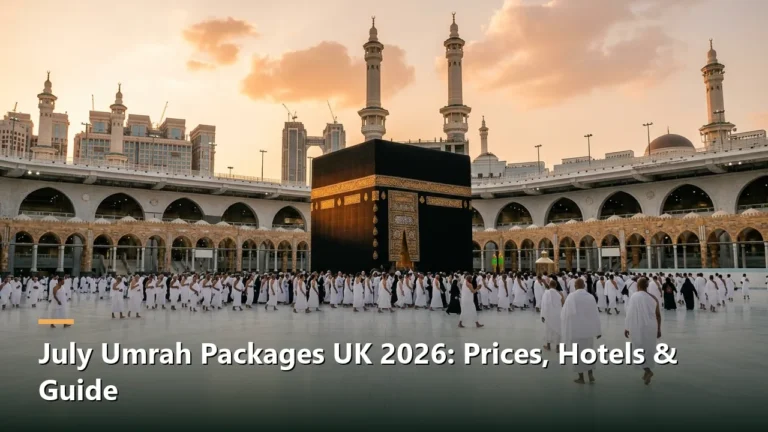
Tawaf means to circle — specifically, to circle the Kaaba seven times in an anti-clockwise direction. It is one of the most profound acts in all of Islamic worship. As you walk around the black-draped cubic structure at the heart of Masjid al-Haram, you are joining hundreds of millions of Muslims who have done the same across fourteen centuries of history.
Before beginning Tawaf, men perform Idtiba — uncovering the right shoulder. Begin at the Black Stone (Hajr al-Aswad), which is set into one corner of the Kaaba. If you are close enough, touch or kiss it. If the crowds make this impossible — and during peak times they usually do — simply face the Black Stone, raise your hand, and say Bismillah, Allahu Akbar. This is entirely valid.
Walk with the Kaaba on your left. Each circuit begins and ends at the Black Stone. After completing all seven circuits, pray two units of Salah (Salat al-Tawaf) behind or near the Station of Ibrahim (Maqam Ibrahim). If this area is too crowded, anywhere within the Masjid is acceptable.
| Practical Tip for UK Pilgrims
The Tawaf area can become extremely crowded, particularly on Friday evenings and during Ramadan. If you feel overwhelmed, move to the outer circuits on the upper floors — they are less crowded and equally valid. Do not put yourself or others in danger by pushing towards the centre during very busy periods. |
Step 3: Performing Sa’i
Sa’i is the act of walking seven times between the hills of Safa and Marwa. It commemorates the desperate search of Hajar for water in the desert, and her unwavering trust in Allah — a trust that was answered with the miraculous spring of Zamzam.
Begin at Safa. Face the Kaaba and make dua. Then walk to Marwa. That is one circuit. Walk back to Safa — that is two. Continue until you have completed seven circuits, finishing at Marwa. The total distance is approximately 3.15 kilometres. There are green-lit sections of the walkway where men are encouraged to jog lightly between the markers — this commemorates the haste with which Hajar searched.
Sa’i can be performed immediately after Tawaf, or you may rest briefly in between. There is no obligation to rush.
Step 4: Halq or Taqsir — Cutting the Hair
The final ritual of Umrah is cutting or shaving the hair. For men, Halq (shaving the entire head) is preferred and carries greater reward, though Taqsir (trimming at least one centimetre from all parts of the hair) is also valid. For women, only Taqsir is required — trimming a small portion from the end of the hair.
Once this is done, your Umrah is complete. You exit the state of Ihram, and all previously prohibited actions are permitted again. Many pilgrims describe the moment of Halq as one of profound emotional release — a literal shedding, a fresh beginning.
After Umrah: What to Do Next
Most pilgrims spend additional days in Makkah performing voluntary Tawaf, praying in the Masjid al-Haram, drinking Zamzam water, and making dua at the various blessed sites. Many then travel to Madinah to visit Masjid an-Nabawi and the Rawdah — the area around the Prophet’s grave.
These additional days are not part of the Umrah itself, but they are among the most spiritually valuable time a Muslim can spend. The duas made in these places, the prayers performed in the Haramain, and the closeness to the history of Islam that permeates every corner of these cities — they leave a mark that many pilgrims say stays with them for the rest of their lives.
Common Mistakes to Avoid
- Missing the Miqat without entering Ihram — always enter Ihram before boarding if unsure of the flight announcement
- Using scented soap or products while in Ihram — pack unscented alternatives specifically for Umrah
- Starting Tawaf from the wrong point — Tawaf must begin and end at the Black Stone
- Performing Sa’i before Tawaf — the correct order is always Tawaf first, then Sa’i
- Trimming only a few strands of hair — Taqsir requires trimming from all around the head
- Neglecting the duas of each stage — learn them before you travel, even if only in English
Book Your Umrah with Safar-e-Kaaba
Safar-e-Kaaba is a UK-based, ATOL-protected Umrah travel agency helping British Muslims perform Umrah with complete confidence. Our packages from London, Manchester, Birmingham, Bradford, Glasgow and Edinburgh include return flights, carefully selected hotels near the Haram, Umrah visa processing, and 24/7 UK support. Call us on +44 2071 930097 or visit safarekaaba.co.uk to get your personalised quote.